
This is another absolutely delightful native plant that is too little known by gardeners and completely ignored by garden centres.
Arkansas calamint (Clinopodium arkansanum) is a low-growing thing with tiny leaves that will slowly make a small mat. It bears small violet-blue flowers in profusion in July. When it is not in bloom, you are most likely to notice it in the wild if you step on it and release the minty fragrance from the leaves. Arkansas Calamint has the sharpest, clearest, most minty smell imaginable, much more pungent than that of true mints (Mentha spp.).

Arkansas calamint does not withstand foot traffic (I know, I know — everyone wants a native equivalent to creeping thyme for foot paths — there just isn’t one) but if you can tuck it into protective crevices between deep stepping stones, you can safeguard the substance of the plant and still occasionally bruise a stray stem. The summer blooming period is very useful in a rock garden, since so many rock garden plants bloom in the spring.
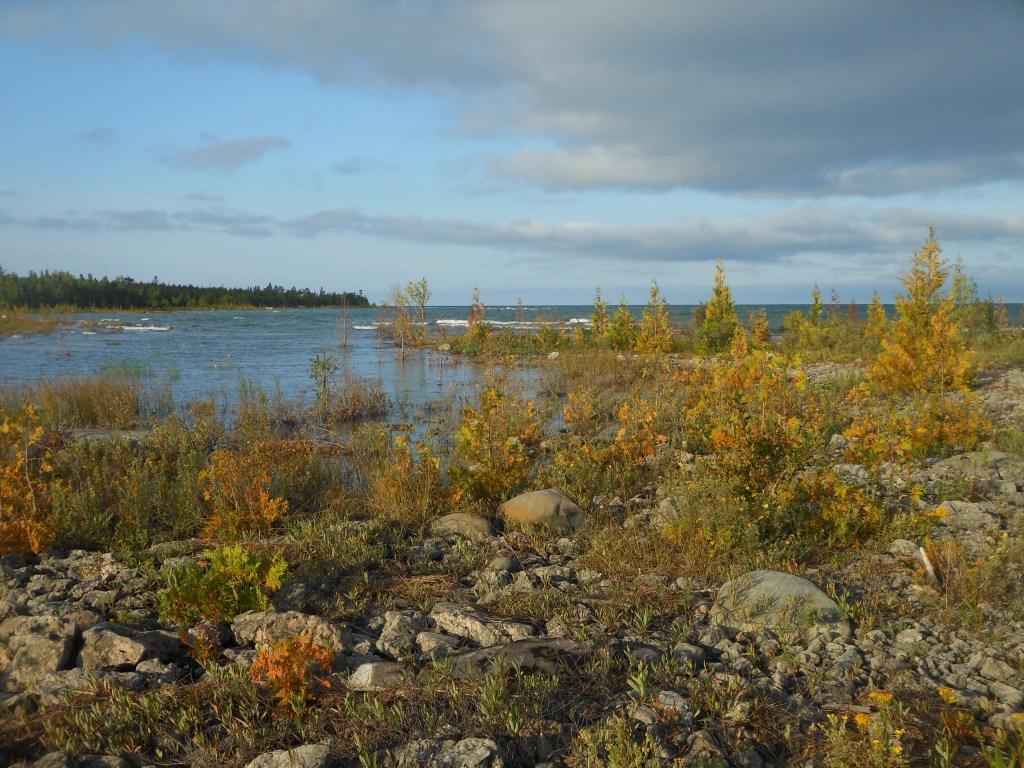
Another name for this plant is limestone calamint and this gives you an important clue to its cultural requirements: it needs to grow on and around limestone rocks. This is not a trifling preference, it is an absolute requirement for this plant. If you do not have limestone rocks, you might want to try it in a largish hypertufa container, the cement component in the hypertufa providing the calcium carbonate to mimic natural limestone. In Arkansas, I believe it grows on cliffs and fossil reefs, but in Ontario it is almost exclusively found on open alvar, ie. exposed limestone pavement. So give it lots of sun and a calcium carbonate based substrate. Its harsh alvar home might lead you to think it is very drought tolerant, but it seems to occur mostly in the cracks and crevices that don’t dry out quite so much, so, until I have experimented with it more in the garden, I am not going to recommend it for very dry locations.
In Ontario, Arkansas calamint occurs on the Bruce Peninsula and on the alvars of the Carden Plain, east of Lake Simcoe, but I don’t see it listed for Lanark County, so it may be one of the wonderful Ontario alvar plants, which, like Prairie Smoke, doesn’t quite make it this far east.
One might suppose that the name ‘calamint’ comes from a portmanteau-ish shortening of calcium and mint, but apparently not. The name originally referred to some European species in the same genus. “Etymology: 14th Century: from Old French calament (but influenced by English mint1), from Medieval Latin calamentum, from Greek kalaminthē“, which might mean ‘beautiful mint’. Beautiful mint is an apt description of this little gem.

 Beaux Arbres Plantes Indigènes / Native Plants
When you mention that you don’t see it listed for Lennar county, where do you look for that kind of information? By the way, lovely flower
LikeLike
Many Field Naturalist groups have compiled county by county lists of plants. for Lanark County, there is an extremely well-produced and informative publication called Plants of Lanark County by David J White, which you can download as a PDF.
LikeLike